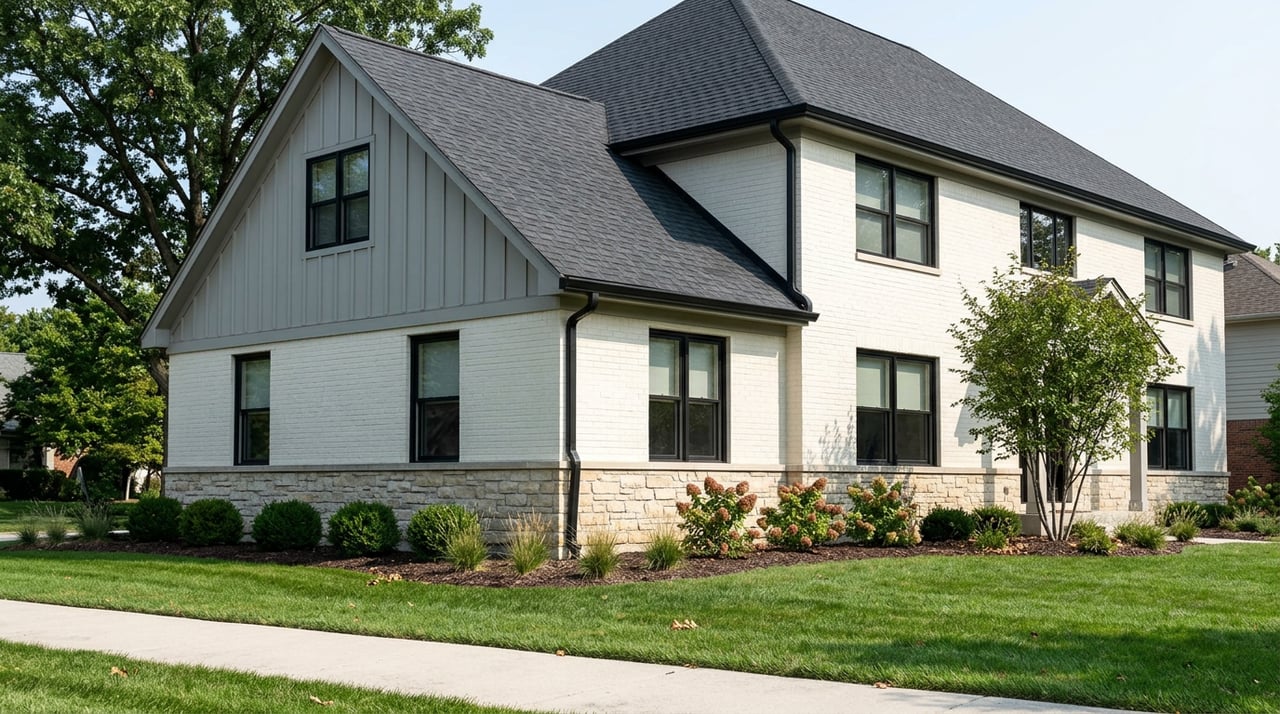
What This Year's Storms Mean for Selling a Home in Lee's Summit
August 13, 2026
August 13, 2026
Picture the sequence most Lee's Summit sellers went through this year. A storm rolls through, a roofer knocks on the door within days, an adjuster signs off, new shingles go on, and the whole episode gets filed under "handled." Then listing season arrives, the disclosure form lands on the kitchen table, and there's a line asking whether any claim has ever been filed for damage to the property. The roof looks perfect. The instinct is to write "no" and move on.
That instinct is the thing worth examining before you list, because Missouri's disclosure rules don't ask what your roof looks like today. They ask what happened to it, whether or not it was fixed.
This was not a quiet year for roofs in Jackson County. On March 10, a severe hailstorm moved through the Kansas City metro with hailstones reported up to four inches in diameter near Weatherby Lake and Kansas City, Kansas, the kind of size that causes damage whether or not a roof shows it from the ground. Then in April, a separate supercell tracked across the southern metro on the Missouri side, dropping golf ball-sized hail, about 1.75 inches, and producing a confirmed tornado over Raymore. That storm's hail and wind reached Lee's Summit zip codes 64063, 64064, 64081, 64082, and 64086, along with Raymore, Grandview, Belton, Pleasant Hill, and Greenwood.
Look at that zip code list against a map of Lee's Summit and there is not much of the city left untouched. Downtown, Chapel Ridge, Greenwood Estates, Summit Lakes, Arborwalk, Winterset, Raintree Lake: most established neighborhoods sit inside one of those five codes. If you own a home here and haven't thought about whether this year's weather touched your roof, this is worth ten minutes before you talk to a listing agent.
Here is the part that catches sellers off guard. Missouri's standard Seller's Disclosure Statement, the form used across the state's real estate transactions, includes a direct question about whether the roof has been repaired, recovered, or replaced during your ownership, separate from a question about whether any claim was ever filed for damage to the property. Answering "yes" to either one requires an explanation, including repair history. A fully resolved claim from March or April still has to be described, with the insurance company's involvement noted if there was one.
One wrinkle worth flagging: older printed versions of this form asked about claims filed in the last five years, while the current form language asks about claims filed during your ownership, a broader window. If your agent hands you a form, confirm which version and which phrasing applies to your situation, since the two aren't asking quite the same question.
The instinct to treat a completed repair as a closed chapter makes sense from a homeowner's perspective. From a disclosure perspective, a repaired roof with documentation is actually the easier story to tell. An undisclosed claim discovered later, through a title search or a buyer's own insurance quote pulling claims history on the address, reads as concealment even when nothing was hidden on purpose.
The safer move is to treat every storm-related repair as a line item you'll need to explain, then make sure the paperwork backs up the explanation before a buyer ever asks.
Before you decide whether to file a claim on hail damage from this year, it helps to understand how Lee's Summit wind and hail deductibles actually work. Unlike a typical car insurance deductible, which is a flat dollar figure, most Missouri homeowner policies set the wind and hail deductible as a percentage of the home's dwelling value rather than a set amount. On a $300,000 home, a 2 percent deductible works out to $6,000 out of pocket before coverage kicks in. On a larger or newer Lee's Summit home insured for more, that number climbs accordingly.
That math changes the calculation for a lot of sellers. If your roof took a light hit and the repair estimate comes in under your deductible, filing a claim buys you nothing financially, and it still creates a disclosable event. If the damage is more serious, the math often favors filing, especially since Missouri's shingle-matching rules can work in a homeowner's favor: when new shingles can't reasonably match existing ones, insurers may cover a full slope or full roof replacement rather than a patch, which is a meaningfully better outcome than a partial repair.
There's also a timing piece that matters if you're weighing a claim right now. Missouri doesn't set one statewide deadline for reporting storm damage, so your specific policy controls the clock, but many carriers expect notice within 30 to 60 days of the storm. If you're still deciding whether the March or April event affected your roof, that window is closing.
The other decision point is actual cash value versus replacement cost coverage, since the two can differ by thousands of dollars on the same claim. Actual cash value pays out the depreciated worth of an older roof, while replacement cost pays to replace it at current prices. Knowing which coverage you carry before you file changes what a claim is actually worth to you, and whether it's worth the disclosure trade-off at all.
Storms aren't the only thing showing up in Lee's Summit disclosure conversations this year. Jackson County sits on expansive clay soil that swells when saturated and shrinks when dry, a cycle local foundation contractors call the clay bowl effect. Combine that with roughly 42 inches of annual rainfall, with May alone typically bringing about 5.7 inches, a 36-inch frost depth, and more than 100 freeze-thaw cycles a year, and the soil under a Lee's Summit foundation is working against the structure in more than one direction at once.
Where this shows up depends heavily on when and where the home was built.
| Area | Typical construction era | What inspectors tend to flag |
|---|---|---|
| Downtown historic district, Lakewood | Decades-old, established lots on rolling terrain | Bowing basement walls, drainage-driven settlement from slope runoff |
| Subdivisions near Chipman Road | 1980s through 2000s growth period | Wall cracks, uneven floors, doors and windows that stop closing properly |
| Summit Lakes, Arborwalk | Newer builds on recently graded farmland | Settlement cracks appearing within the first few years as fill soil compacts |
None of this means a Lee's Summit home has a defect that should scare off a buyer. It means the region's soil produces predictable, well-understood findings that show up on a home inspection whether or not a storm ever touched the property. Local foundation contractors put typical repair costs in a fairly consistent range: steel pier systems run $1,250 to $2,500 per pier, with most settlement projects needing six to twelve piers, structural reinforcement for bowing walls runs $350 to $1,000 per application, and a full waterproofing system with drain tile and a sump pump typically falls between $4,000 and $7,000. A full foundation repair project in Jackson County often lands somewhere between $3,000 and $15,000 depending on scope.
Knowing these ranges before a buyer's inspector flags a crack means you're negotiating from information instead of surprise.
Do I have to disclose a hail claim if I decided not to file one? The disclosure form's claims question applies to claims actually filed. If you had damage but never filed, that specific question may not apply, though the separate roof repair or replacement question still does if you paid for repairs out of pocket.
What if the roof was replaced by a previous owner, not me? The claims and repair questions on the current form are generally tied to your period of ownership. If you have no knowledge of what happened before you owned the home, you're not expected to disclose what you don't know, but any records that came with the sale should still be shared if you have them.
Does a foundation crack disqualify a home from selling in Lee's Summit? No. Given the region's clay soil, some degree of settlement is common and well understood by local inspectors and buyers alike. Disclosed and documented issues, with repair estimates in hand, tend to move through negotiation far more smoothly than issues a buyer's inspector finds first.
How far back does the claims question actually reach? Sources vary here. Some printed versions of the form ask about claims within the last five years, while current language asks about your full ownership period. Confirm which version your transaction is using rather than assuming either applies.
Selling a home after a year like this one isn't about hiding what happened, it's about walking into the conversation already knowing what a buyer's inspector will find and having the paperwork ready before they ask. That's the kind of preparation that keeps a Lee's Summit closing on schedule instead of stalled at the negotiating table. If you want help thinking through your specific storm history, your deductible math, or what your neighborhood's soil tends to reveal, Sherry Lynn & Co is happy to walk through it with you before you list.
Stay up to date on the latest real estate trends.



Experience a team that’s committed to results, service, and making the process smooth—and even fun.

SHERRY LYNN WESTHUES